
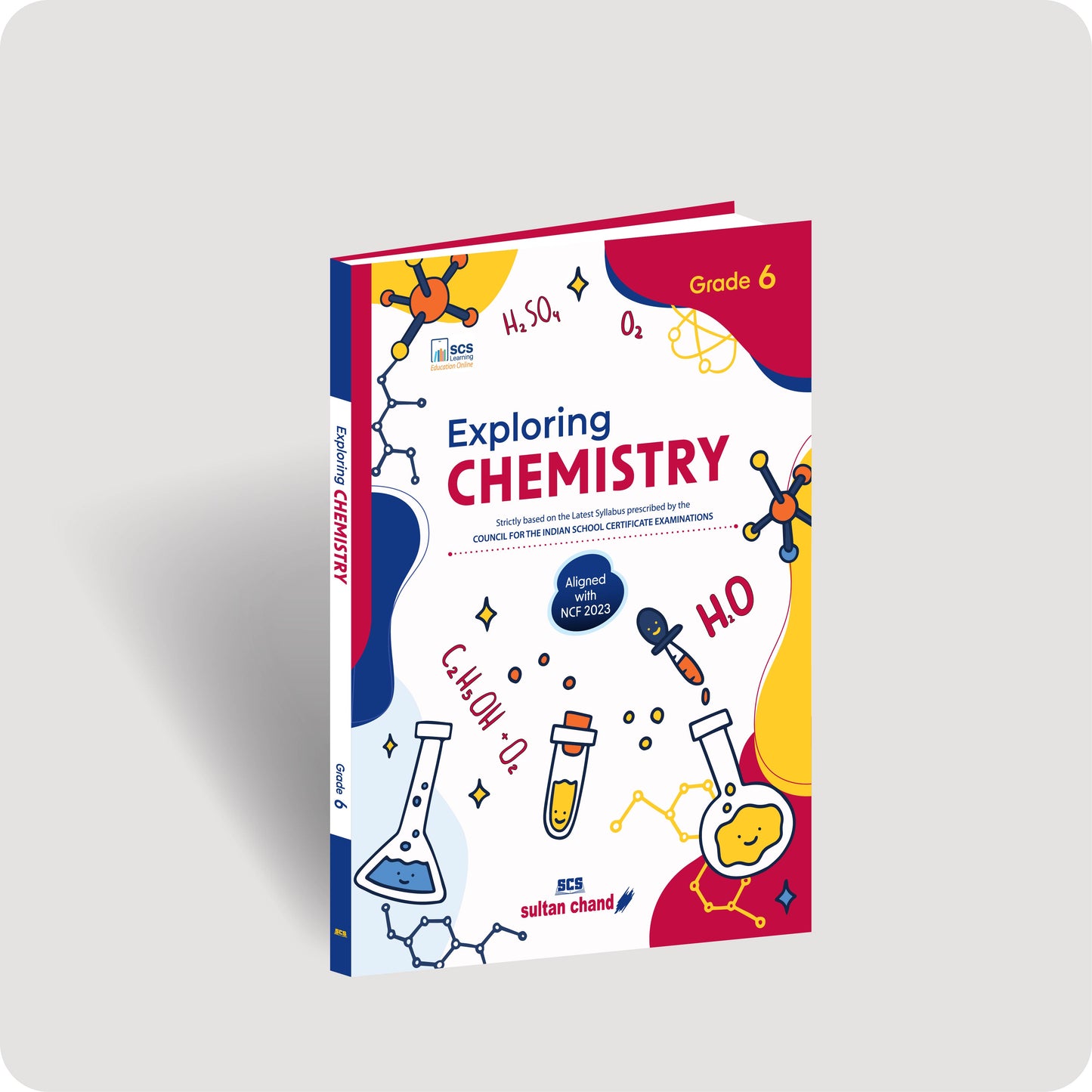
Exploring Chemistry: Textbook for ICSE Grade 6 (2026-27 Session)
Author: Dr. Sunita Hooda, Dr. Geetu Gambhir
It gives us immense pleasure to present this latest edition of Exploring Chemistry for ICSE Grade 6. The textbook, carefully designed to meet the requirements of the
latest syllabus, is written in a student-friendly language and aims to nurture curiosity, develop scientific temperament and build a strong foundation in Chemistry.
Chemistry is often described as ‘central science’ because it connects the principles
of Physics with the applications of Biology, Medicine, Engineering and
Environmental Studies. With this thought in mind, we have structured the chapters in a logical sequence, beginning with the basics and gradually progressing
towards real-life applications. Each chapter contains clear explanations, illustrative examples, activities and exercises that encourage self-learning and critical
thinking.
This edition has been aligned with the latest ICSE curriculum, ensuring that
learners are not only exam-ready but also conceptually strong. The book also
integrates Case-based Questions, Image-based Questions and Higher-Order Thinking Skills (HOTS) Questions to help students relate Chemistry to their daily life and surroundings.
The book comprises five carefully designed chapters:
1. Introduction to Chemistry: This opening chapter introduces Chemistry as a subject, explaining its meaning, scope and importance in everyday life. It also touches upon the history of Chemistry, industrial applications, and the use of scientific methods.
2. Elements, Compounds and Mixtures: Students will learn about the characteristics of elements, compounds and mixtures, as well as various techniques used to separate the components of mixtures. Everyday examples are provided to strengthen understanding.
3. Matter: This chapter explains the fundamental classification of matter. It focuses on the states of matter—solid, liquid and gas—along with their properties and interconversions. The state of matter is explained with engaging experiments, such as diffusion and changes of state. Special emphasis is given to scientific reasoning behind daily observations.
4. Water: As one of the most essential resources on Earth, an entire chapter has been dedicated to water. Its composition, properties and significance in life processes are described in detail. Methods of purification and water conservation are also discussed, encouraging environmental awareness and responsibility among students.
Preface
5. Air and Atmosphere: This chapter explains the composition of air and the properties of its constituents such as oxygen, nitrogen and carbon dioxide.
Students will also learn about the atmosphere and its role in sustaining life
on Earth. Current issues like air pollution, global warming and the need for sustainable practices are discussed using suitable case studies.
Special care has been taken to include illustrations, activities and real-world connections to make learning interactive and enjoyable. Chapter-end exercises and a Model Test Paper given at the end of the book provide graded questions, ranging from simple recall to application and reasoning-based problems.
Share
